Origins
The History of the Sisters of Saint-Gildas
The history of the Congregation begins in Morbihan, in the commune of Beignon—the home of its founders, Gabriel Deshayes and Michelle Guillaume. Like many others, this rural parish had been left in a state of profound human and spiritual poverty by the French Revolution.
Gabriel Deshayes, a priest, was deeply concerned by this situation. Together with Michelle Guillaume—a local young woman who wished to enter religious life—he founded a school to educate and provide religious instruction to girls from the countryside.
Their project was launched on May 5, 1807.
Michelle Guillaume’s readiness to serve, combined with the boldness and apostolic zeal of Gabriel Deshayes, transformed this initial, modest mission into the beginnings of the Congregation of the Sisters of Christian Instruction, known as the Sisters of Saint-Gildas.
Beignon
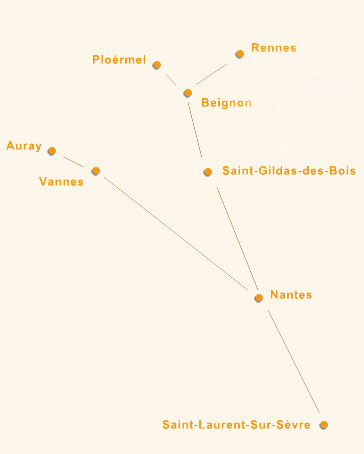
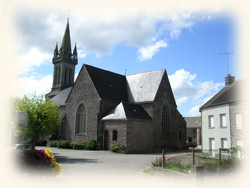 Beignon is a commune in the Morbihan department, located approximately 40 km from Rennes and traversed by the Aff River. It lies near the Forest of Brocéliande and the Coëtquidan military camp.
As the home of the founders of the Sisters of Christian Instruction—Gabriel Deshayes and Michelle Guillaume—Beignon is known as the “Cradle” of the Congregation.
Saint-Gildas-des-Bois
The work was expanding rapidly. Father Gabriel Deshayes, the founder, needed to find a larger house to accommodate the nascent Congregation. In 1828, he acquired the Benedictine abbey of Saint-Gildas-des-Bois in Loire-Atlantique, which had been abandoned since the Revolution.
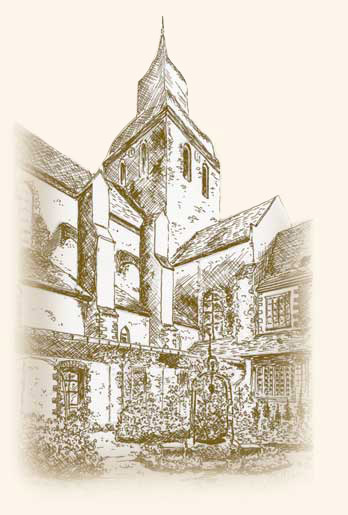 The abbey of Saint-Gildas-des-Bois was founded in the 11th century by Simon de Rupe, Lord of La Roche-Bernard. It took its name from a holy monk, Gildas, whose relics were brought there from Rhuys. All that remains from the distant past are the church, built in the 12th century, and the old well inside the cloister. By the time of the Revolution, only five religious remained.
The abbey became “national property” and subsequently private property.
Father Deshayes purchased the buildings and grounds, which had been put up for sale by the last heirs. He needed a house spacious enough to accommodate the young congregation he had founded in Beignon with Michelle Guillaume.
In August 1828, the Sisters of Christian Instruction arrived at their new home to find the buildings in a state of disrepair. They faced a difficult beginning there, marked by extreme poverty.
In early 1830, the Annals note that “the work was on the verge of ruin for lack of instruction and means of subsistence.” Gabriel Deshayes had been living in Saint-Laurent-sur-Sèvre since 1821. He asked the Bishop of Nantes, Monsignor de Guérines, to appoint a Superior for Saint-Gildas. The Bishop appointed Monsieur Angebault to succeed him.
Key milestones in the history.
Throughout the 19th century, attentive to the needs of the people and the calls of the Church, the Congregation expanded:
1903
1901–1904: Following the laws passed in France regarding the separation of Church and State and the ban on religious orders teaching, the Congregation chose to secularize and to relocate abroad. In September 1903, Sisters settled in Langport, Somerset (England). This marked the beginning of a missionary presence that would continue to grow. They founded schools and welcomed day students and boarders of all denominations, particularly Anglicans.
1914–1918; 1939–1945
The Congregation was deeply affected by the two wars that swept across Europe. The Motherhouse and the Sisters dedicated themselves to welcoming and caring for soldiers and the wounded. For a time, the Motherhouse was occupied by German soldiers.
After the Second World War
In France, the Congregation established communities in the Paris region and other dioceses to maintain a presence in both working-class and rural areas. While remaining committed to education, healthcare, and pastoral work, some Sisters began to engage in social welfare activities.
1957
In September, two Sisters were sent to Blacklion, Ireland, to serve at a White Fathers seminary.
1958
Calls from the Universal Church regarding Latin America and Africa became increasingly urgent. Three Sisters departed for Réo, in the Diocese of Koudougou (Upper Volta, now Burkina Faso).
1979
The Congregation decides to open a community in Ghana: sisters from the England Region leave for Tamale in Northern Ghana and establish the mission in the country.
1989
The Congregation opens a novitiate in Kokologho for the West Africa Region.
1990
The Congregation decides to send sisters on a mission to Quiégolani, Mexico, to work among an indigenous population—the Zapotec people.
2000
Formation of the *Chemin d’Emmaüs* (Road to Emmaus) Federation, an alliance of four congregations
(Providence of Saint-André de Peltre / Providence of Ruillé / Providence of Sées / Sisters of Saint-Gildas) sharing a common charism and spirituality.
2006
Formation of the *Famille Gildasienne* (Gildasian Family), a spiritual family for laypeople wishing to live out the Gospel in the spirit of the Sisters of Saint-Gildas.
21st Century
Like many others, the Congregation faces a lack of new vocations and an aging membership in Europe.
In West Africa, young women are joining the Sisters of Saint-Gildas. The mission continues, and ministries are expanding. The sisters are undergoing training and taking on responsibilities in education, healthcare, social services, and pastoral work.